RIR Explained The Metric Most Lifters Ignore
RIR Explained
The Metric Most Lifters Ignore
Most lifters track weight.
Some track reps.
Almost no one tracks how hard the set actually was.
That missing piece is why progress stalls — even when numbers look good on paper.
Enter RIR.
What Is RIR?
RIR stands for Reps In Reserve.
It answers one simple question:
_“How many more reps could I have performed before true failure?”_
Examples:
- RIR 0 → You hit failure
- RIR 1 → One more rep left
- RIR 3 → You stopped early
Two lifters can perform the same weight and reps
and experience completely different training stimuli —
all because of RIR.
Why Weight and Reps Alone Are Misleading
“3 × 10 @ 80 kg” looks precise.
It isn’t.
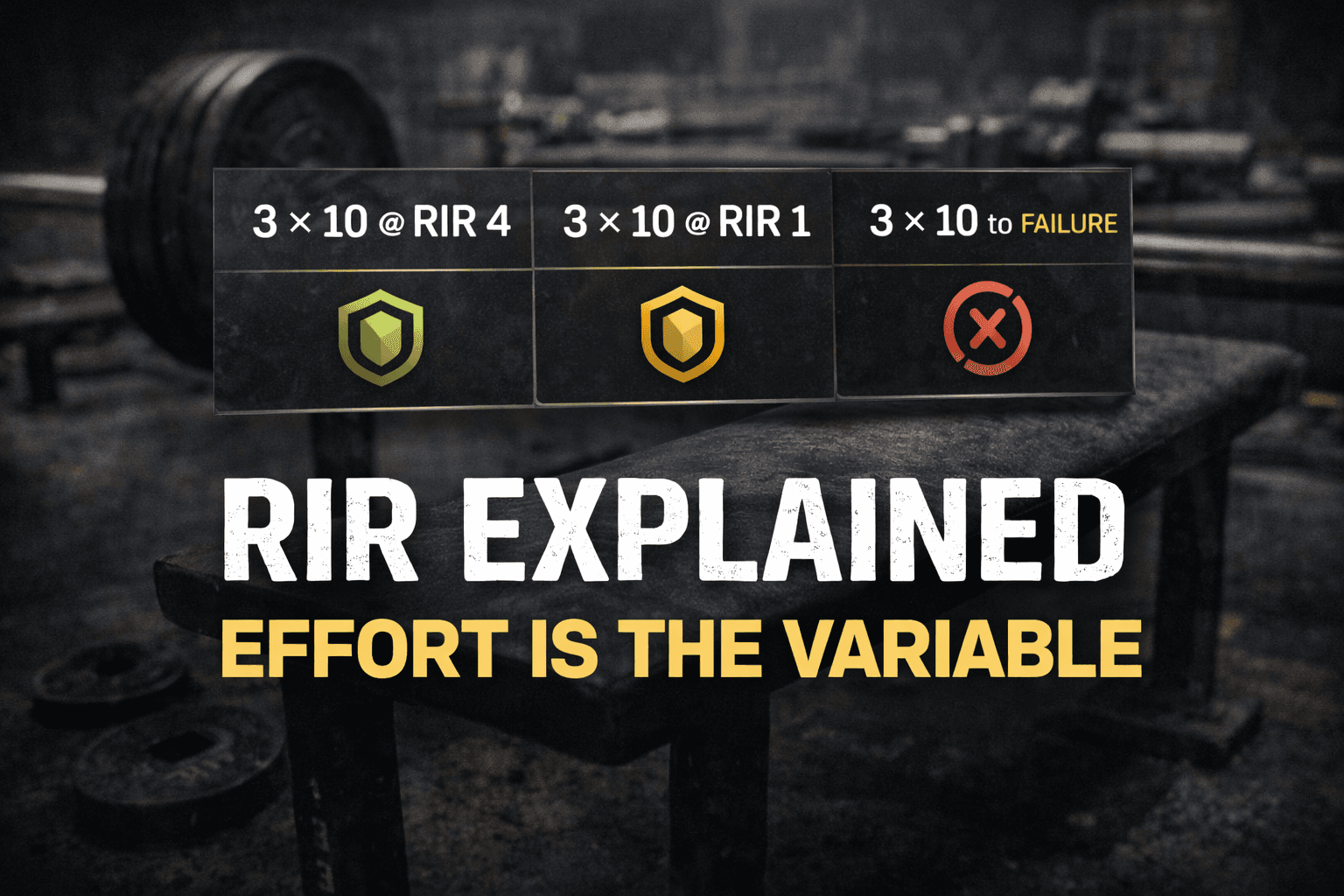
- 3 × 10 @ RIR 4 → barely stimulative
- 3 × 10 @ RIR 1 → hypertrophy-focused
- 3 × 10 to failure → completely different fatigue cost
Most workout logs treat these as identical.
They’re not even close.
Without RIR, your data lies to you.
RIR Is the Bridge Between Effort and Adaptation
Muscle growth doesn’t respond to effort _intentions_.
It responds to proximity to failure.
Both research and real-world coaching agree:
- Most hypertrophy occurs between RIR 0–2
- Going to failure too often increases fatigue
- Staying too far from failure limits stimulus
RIR allows you to:
- Push hard without guessing
- Manage fatigue across weeks
- Progress intelligently instead of randomly
Why Most Lifters Ignore RIR
Because it’s uncomfortable.
Tracking RIR forces honesty:
- Was that set actually hard?
- Did you stop because it burned — or because you quit?
- Are you progressing, or just repeating numbers?
It’s easier to log weights
than to log effort.
But effort is what builds muscle.
RIR and Progressive Overload
Progression isn’t just:
“Add more weight.”
It can also be:
- Same weight, lower RIR
- Same RIR, more reps
- Same reps, better control
Example:
- Week 1: 80 kg × 8 @ RIR 3
- Week 2: 80 kg × 8 @ RIR 1
That’s real progress — even if the weight didn’t change.
Without RIR, you miss it.
The Problem With Guessing RIR
Yes, RIR is subjective.
That doesn’t make it useless.
Accuracy improves when:
- You log consistently
- You compare similar sets
- You review past performance
And if your system reminds you of last session’s RIR,
your estimates sharpen over time.
RIR isn’t about perfection.
It’s about directional accuracy.
How Serious Lifters Should Use RIR
As a baseline:
- Compound lifts: RIR 1–2
- Isolation movements: RIR 0–1
- Deload phases: RIR 3–4
More importantly:
- Track it per set
- Compare it week to week
- Use it to guide load, not ego
Final Thought
Most lifters chase numbers.
Serious lifters chase stimulus.
RIR is the missing variable that connects:
- Weight
- Reps
- Effort
- Results
Ignore it, and you’re guessing.
Track it, and your training becomes intentional.
And intentional training is where real progress starts. 💪